
I would highly recommend Rowland Emergency to any EMS provider. I have been working with them for over 35 years and they have always provided top-notch parts and service for all our EMS fleet needs. This three-generation Canadian family business is a pleasure to deal with.
-
SKU: R-606064
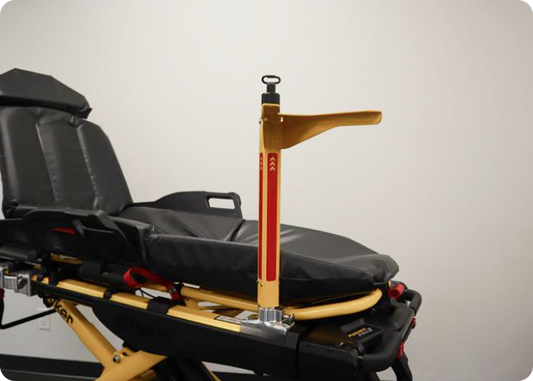
Critical Care Pole Mount for Ferno D360, Hamilton T1, and CardioHelp for Stryker Power-PRO XT and Power-PRO 2
The Critical Care Pole with Adaptor to Mount Ferno D360 is a custom-designed cot-mounted pole engineered to seamlessly integrate with the Ferno D360 mounting system, enhancing overall functionality for medical professionals. Please note that the Ferno D360 adaptor is not included. The hardware ki...
Secure Device Mounting for Critical Care Transport
Rowland Emergency's Ferno D360-compatible mounting poles are designed for critical care and neonatal transport applications. These stretcher-mounted solutions support compatible devices such as the Hamilton T1, CardioHelp, and other Ferno D360-compatible equipment. They help organize medical equipment, reduce clutter around the stretcher, and support efficient patient transport workflows.
Popular Mounting Poles compatible with Medical Adaptors by Ferno

Critical Care Pole Mount for Ferno D360 (Compatible with Hamilton T1, CardioHelp, etc.)
Designed for use with the Ferno D360 mounting system, this critical care pole is compatible with supported Stryker Power-PRO and MX-PRO stretcher platforms. It is available with or without an IV receptacle to accommodate different equipment configurations and provides a dedicated mounting solution for compatible monitors, ventilators, and other medical devices during patient transport.

Customer Support
For further assistance or to learn more about our warranty details, please get in touch via our live chat. Our dedicated team is ready to help you with any questions or concerns you may have.

About Rowland Emergency
Since 1957, Rowland Emergency has been at the forefront of providing end-to-end custom EMS solutions. With a commitment to excellence and a deep understanding of the needs of emergency medical service providers, we strive to deliver products that meet the highest standards of quality and innovation. Our mission is to improve emergency medical care and response, ensuring that patients receive the best possible outcome.
Frequently Asked Questions
What are Ferno D360-compatible medical device mounting poles used for?
These adapter poles allow compatible Ferno D360-equipped medical devices to be mounted on supported Stryker stretcher systems using compatible Rowland Emergency mounting components.
Are these mounts suitable for EMS and ambulance use?
Yes, these mounting poles are designed for emergency medical service environments. They are made to support equipment used by paramedics, critical care teams and emergency response providers.
What type of equipment can be mounted on these poles?
These poles may support critical care and transport equipment such as defibrillators, ventilators, monitors and other compatible medical devices. Always check the product details to confirm device compatibility.
Are the Ferno mounting poles built for demanding EMS environments?
Yes. The mounting poles are manufactured from durable materials for repeated use in EMS and critical care transport environments. They provide dedicated mounting locations for compatible medical equipment.
Why is a dedicated mounting pole important for medical devices?
A dedicated mounting pole provides a designated mounting location for compatible medical equipment, helping maintain an organised patient compartment while keeping devices readily accessible during patient transport.